
BLOCKED DOESN’T MEAN STOPPED
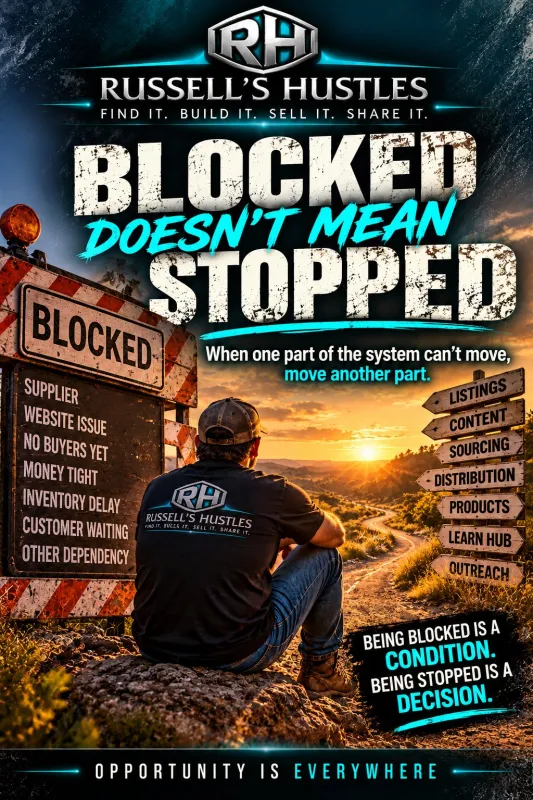
BLOCKED DOESN’T MEAN STOPPED
When one part of the system can’t move, move another part.
Eventually, something is going to get in your way.
Actually, let me correct that.
A lot of things are going to get in your way.
A supplier doesn't answer.
The website isn't working.
A customer says they're coming and doesn't show.
The product you need is out of stock.
Money gets tight.
Something breaks.
You're waiting for somebody else to finish their part before you can finish yours.
And suddenly the thing you planned to accomplish today...
can't be accomplished today.
That's frustrating.
But there's a difference between having one thing blocked and having everything stopped.
Learning that difference can completely change the way you work.
ONE ROAD IS NOT A SYSTEM
Imagine you're driving somewhere and come across a road closure.
You can park your car in front of the barricade, stare at it and complain that you can't get where you're going.
Or you can find another road.
Your destination didn't disappear because one road closed.
You simply need another route.
Business works the same way.
If your entire day depends on one thing happening, one person responding, one customer buying, one supplier delivering or one piece of technology working...
you don't really have a system yet.
You have a road.
And when that road closes, everything stops.
A system gives you multiple ways to create progress.
SEPARATE WHAT YOU CONTROL FROM WHAT YOU DON'T
This is one of the simplest things you can do when you're blocked.
Ask yourself:
Is the next step actually mine?
If you're waiting for somebody to respond, you've already done your part.
If you're waiting for inventory to arrive, staring at the tracking information isn't going to make the truck drive faster.
If a website problem requires someone else to repair it, refreshing the page every ten minutes isn't progress.
You've reached the point where the next move belongs to somebody else.
That's when you need another question:
What still belongs to me?
Maybe you can photograph inventory.
Write descriptions.
Organize your workspace.
Create content.
Research your next product.
Follow up with another customer.
Improve an existing listing.
Learn something you've been putting off.
Clean up your records.
Work another sales channel.
There is almost always something inside the system that still belongs to you.
Move that.
DON'T CONFUSE WAITING WITH WORKING
This one can sneak up on you.
Waiting can feel like work because your brain is still occupied by the problem.
You're checking your phone.
Refreshing your email.
Watching for a message.
Thinking about what somebody might say.
Replaying the problem.
You're mentally exhausted by it.
But nothing is actually moving.
That's not productive waiting.
That's just being held hostage by something you don't control.
Sometimes the most productive thing you can do is say:
I've done my part. Now I'm moving to the next thing.
That doesn't mean you forget about the original problem.
It means you stop allowing it to consume resources it doesn't need.
Your time.
Your attention.
Your energy.
Those resources can be working somewhere else.
BUILD A SYSTEM WITH PARALLEL PATHS
This is where systems become powerful.
Think of your work as several lanes running beside one another.
One lane might be sales.
Another might be inventory.
Another might be marketing.
Another might be content.
Another might be customer service.
Another might be sourcing.
Another might be learning.
Another might be administration.
They all contribute to the same larger goal.
That means every lane doesn't have to move at the same speed every day.
Sales might be slow while you're making progress on inventory.
Inventory might be delayed while you're improving marketing.
A technical problem might stop one project while you create something completely different.
The important thing is that the whole operation continues moving.
That's what a system gives you.
Options.
BUT DON'T USE "PROGRESS" TO AVOID THE HARD THING
There's another side to this.
And it's important.
"Working on something else" can become a very convenient excuse.
You don't want to make the sales call, so you reorganize your desk.
You don't want to post the product, so you spend three hours changing the picture.
You don't want to hear "no," so you decide today is the perfect day to research something that might matter six months from now.
That's not moving around a blockage.
That's avoidance.
There's an easy test.
Ask:
Can I actually move the blocked task right now?
If the answer is yes, move it.
Do the uncomfortable thing.
Make the call.
Post the listing.
Send the message.
Finish the job.
But if the answer is genuinely no because the next step depends on something outside your control...
then move another part of the system.
There's a big difference.
KEEP A "WHILE I'M WAITING" LIST
Here's a practical system you can use immediately.
Create a list called:
WHILE I'M WAITING
Put useful tasks on it that don't depend on anyone else.
Not busywork.
Things that actually move your goal forward.
Maybe yours includes:
- Photograph three products
- Improve one listing
- Contact one potential customer
- Organize inventory
- Write one piece of content
- Research one sourcing opportunity
- Review expenses
- Package an order
- Learn one skill you actually need
- Follow up on an old lead
Now when something gets blocked, you don't have to decide what to do next.
You've already decided.
Pick something from the list.
Move it.
That's a system.
PROGRESS DOESN'T ALWAYS LOOK LIKE THE PLAN
This might be the hardest part to accept.
We like progress to look the way we imagined it.
Today I will accomplish A.
Then B.
Then C.
Beautiful.
Except real life doesn't care about our little alphabet.
Sometimes you start A, get blocked, jump to D, finish F, return to B, discover C isn't necessary anymore and somehow end the week further ahead than the original plan would have taken you.
That's not failure.
That's adaptation.
And the ability to adapt without losing direction is one of the most valuable systems you can build.
The goal isn't to perfectly follow the plan.
The goal is to keep creating meaningful progress toward the destination.
BLOCKED IS NOT THE SAME AS STOPPED
There will always be things you can't control.
People.
Technology.
Money.
Timing.
Weather.
Customers.
Suppliers.
Circumstances.
You don't need a system that magically prevents those things from happening.
You need a system that keeps functioning when they do.
That's the difference.
When one road closes, find another road.
When one lane slows down, move another lane.
When the next step belongs to somebody else, find the next step that belongs to you.
And when the blockage clears?
Come back.
Pick it up.
Keep moving.
Because:
Being blocked is a condition.
Being stopped is a decision.
And if there's still something meaningful you can move today...
you're not stopped yet.
Opportunity Is Everywhere.
Find It. Build It. Sell It. Share It.