
I DON'T KNOW HOW
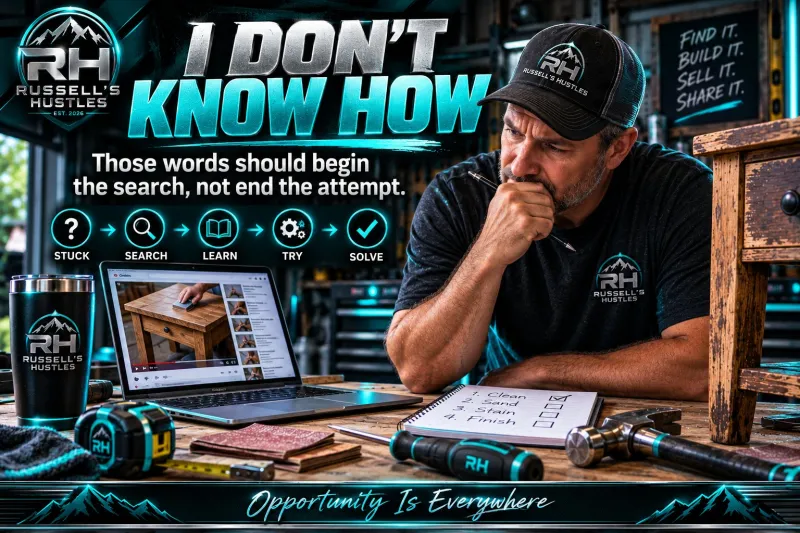
I DON'T KNOW HOW
Those words should begin the search, not end the attempt.
“I don't know how.”
How many things have ended with those four words?
An idea.
A project.
A repair.
A business.
Something we wanted to create.
Something we wanted to try.
Something sitting right in front of us that might have been possible if we had simply stayed with it a little longer.
There is absolutely nothing wrong with saying, “I don't know how.”
Sometimes that's the most truthful answer we can give.
The problem begins when we quietly turn those words into:
“So I can't.”
Those are not the same statement.
Not even close.
NOT KNOWING IS A STARTING POINT
Think about almost anything you know how to do today.
There was a time when you didn't know how to do it.
You didn't know how to drive.
You didn't know how to use the software you use now.
You didn't know how to do your job.
You didn't know how to cook that meal, operate that tool, fix that problem, or complete that task.
Then something happened.
You learned.
Maybe somebody showed you.
Maybe you read the instructions.
Maybe you watched someone else.
Maybe you tried it, messed it up, figured out what went wrong, and tried it again.
Eventually something that once felt unfamiliar became ordinary.
That's what learning does.
It turns “I don't know how” into “I know how now.”
WE HAVE MORE ACCESS TO KNOWLEDGE THAN EVER
This is the part that makes our willingness to give up so quickly a little harder to defend.
Look at what we have available to us.
Search engines.
DIY videos.
Step-by-step tutorials.
Online classes.
Forums.
Manuals.
Articles.
Libraries.
Communities built around almost every subject imaginable.
And now AI tools that allow us to ask questions, explain what we're struggling with, and work through problems in ways that weren't available to most of us just a few years ago.
If you want to learn how to refinish a table, somebody has probably filmed it.
If you want to replace a part on an appliance, somebody has probably filmed it.
If you want to learn how to photograph something better, build a spreadsheet, edit a video, start a garden, repair something, use a new program, cook something you've never cooked, or understand how something works...
There is a very good chance somebody has already taken the time to teach it.
And probably more than one somebody.
Sometimes there are so many tutorials that the hardest part is deciding which one of the 487 videos to watch.
The information isn't always the problem anymore.
Our willingness to stop and learn can be.
SOMETIMES “I CAN'T” REALLY MEANS “I HAVEN'T LEARNED”
There is an important difference between these statements:
I can't do this.
I don't know how to do this.
I haven't learned how to do this yet.
And maybe the most uncomfortable one:
I haven't taken the time to learn how to do this.
That last one puts some responsibility back in our hands.
Because sometimes we decide something is beyond us before we've watched the first video, read the first page, asked the first question, or made the first attempt.
We haven't failed.
We haven't even become the student yet.
BECOME THE STUDENT
There is no embarrassment in not knowing something.
Nobody knows everything.
But when you encounter something you don't understand, try replacing frustration with curiosity.
Instead of:
“How am I supposed to know how to do this?”
Try:
“What do I need to learn first?”
That's a completely different question.
One leaves you staring at the entire problem.
The other gives you somewhere to begin.
You don't have to understand everything at once.
Learn the first piece.
Then the next.
Then try something.
See what happens.
Ask another question.
Correct what didn't work.
Try again.
That's learning.
It doesn't always happen neatly.
It doesn't always happen quickly.
And sometimes it involves discovering seventeen new things you didn't know while trying to learn the one thing you thought you needed.
Welcome to the club.
WATCHING ISN'T LEARNING UNTIL SOMETHING CHANGES
There is another trap here.
We can consume information all day long and convince ourselves we're learning.
Twenty videos saved.
Fifteen articles bookmarked.
Three podcasts listened to.
A folder full of screenshots.
And nothing actually attempted.
Information becomes useful when we begin doing something with it.
Watch the tutorial.
Then pick up the tool.
Read the instructions.
Then follow them.
Learn the process.
Then try the process.
You may get it wrong.
Good.
Now you have something information alone couldn't give you:
experience.
You know where you struggled.
You know which part didn't make sense.
You know what question to ask next.
The second attempt is no longer being made by the same person who made the first.
That person knows more now.
DON'T EXPECT YOURSELF TO BE GOOD AT SOMETHING YOU JUST LEARNED
This one gets adults all the time.
We try something once.
It doesn't turn out the way we imagined.
And suddenly:
“Well, apparently I'm not good at this.”
Of course you're not.
You just started.
Why would your first attempt look like somebody else's hundredth?
The person teaching that DIY project probably didn't become good at it the morning they recorded the video.
The person who makes something look effortless has often repeated it enough times that you no longer see the learning that came before the skill.
Give yourself permission to be new.
Not careless.
Not reckless.
New.
There is a difference.
LEARNING DOESN'T MEAN DOING EVERYTHING YOURSELF
There is an important boundary to all of this.
Some things require professionals.
Some things involve safety, licensing, specialized training, expensive equipment, or consequences that aren't worth experimenting with.
Learning doesn't mean deciding you can perform surgery because you found a twelve-minute video.
Sometimes learning enough about something teaches you the most valuable lesson of all:
This is where I call somebody who knows what they're doing.
That's not defeat.
That's wisdom.
The goal isn't to prove you can do everything yourself.
The goal is to stop assuming you can do nothing simply because you don't already know how.
CHANGE THE QUESTION
The next time you catch yourself saying:
“I don't know how.”
Don't fight the statement.
It may be completely true.
Just don't put a period after it.
Add a question.
I don't know how. Where can I learn?
I don't know how. Who could show me?
I don't know how. Is there a tutorial?
I don't know how. What's the first part I need to understand?
I don't know how. What would happen if I took an hour and tried to learn?
That tiny change matters.
Because now you're no longer declaring what you cannot do.
You're identifying what you need to learn.
TAKE THE TIME
Maybe that's the real challenge.
Not intelligence.
Not talent.
Not age.
Not whether we're naturally “good with our hands” or “good with computers.”
Time.
Learning requires us to slow down long enough to admit we don't know something, find good information, pay attention, try, fail occasionally, ask another question, and try again.
Sometimes we don't want to do that.
We want to know now.
We want it to work now.
We want somebody else to handle it because learning it feels inconvenient.
And sometimes paying someone else absolutely makes sense.
But before you surrender something you genuinely want to understand, create, repair, build, or accomplish, ask yourself one honest question:
Do I actually lack the ability to do this, or have I simply not taken the time to learn how?
Those are very different problems.
One may stop you.
The other can be changed.
So the next time those four words show up, say them.
“I don't know how.”
And then open the door they should have been opening all along:
“Let's find out.”
“I don't know how” should begin the search, not end the attempt.
Opportunity Is Everywhere.
Sometimes the opportunity is simply learning something today that you couldn't do yesterday.
Find It. Build It. Sell It. Share It.